
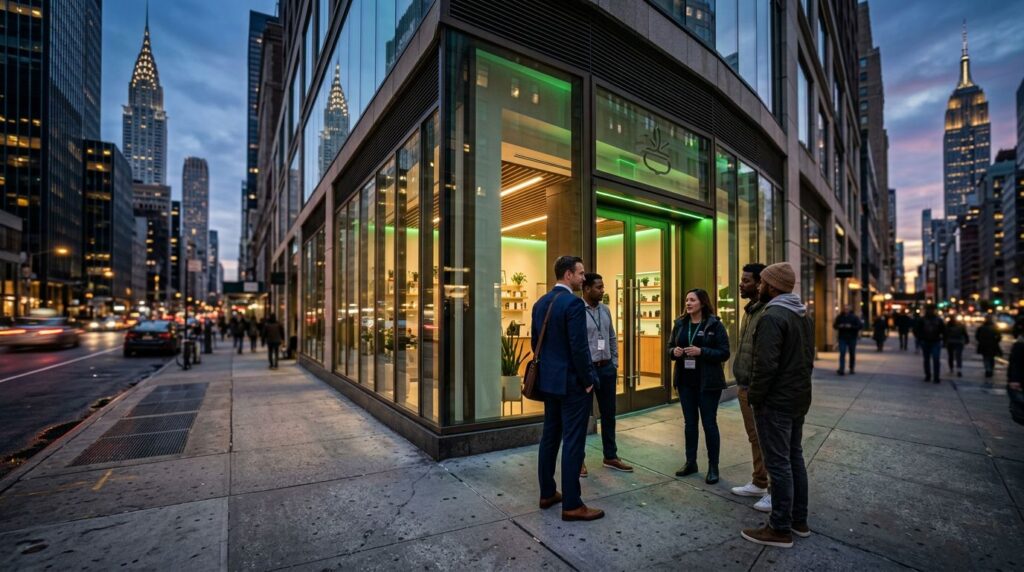
When New York made its first legal adult-use cannabis sale in Manhattan on December 29, 2022, you were seeing more than a store opening. You were seeing a policy decision in action.
That decision was the Conditional Adult-Use Retail Dispensary program. By prioritizing New York CAURD licenses, the state determined who could open their doors first, where equity would sit in the market, and how every adult-use retail dispensary would define the beginning of this new legal era.
Key Takeaways
- Equity-First Rollout: The CAURD program prioritized justice-involved individuals and nonprofits for the first wave of retail licenses, ensuring that those most impacted by past prohibition were the first to participate in the legal market.
- Small-Scale Foundation: By restricting licenses to a single retail location per operator, the state prevented a chain-first expansion and established a local, community-focused foundation for the new industry.
- Regulatory Complexity: The launch faced significant hurdles, including legal challenges, complex real estate requirements, and logistical delays, which affected the speed of dispensary openings and the growth of the legal market footprint.
- Symbolic Legitimacy: Early CAURD dispensaries served as the face of New York’s legal cannabis market, setting high standards for compliance, age-gating, and public accountability to distinguish themselves from unlicensed competitors.
Why New York opened with CAURD
If you want to understand New York’s first legal dispensaries, start with the license itself. The Office of Cannabis Management launched the Conditional Adult-Use Retail Dispensary (CAURD) program as the state’s primary vehicle for opening the market. Under the CAURD FAQ, these were the first adult-use retail dispensary licenses issued in New York.
That choice mattered because licensing sets the shape of a market long before most shoppers notice it. When the state decides who gets in first, it also affects store ownership, local hiring, neighborhood presence, and how fast legal access spreads. To qualify for these New York CAURD licenses, applicants had to demonstrate a significant presence in New York, ensuring the shops remained rooted in the local economy.
The program focused on justice-involved individuals, along with certain nonprofits connected to communities harmed by past prohibition. Specifically, the state prioritized those who had been convicted of a marihuana-related offense or had a family member who had. In plain terms, the first legal stores were not meant to go first to the biggest investors. They were meant to go first to justice-involved individuals and groups with a direct link to the harm caused by decades of enforcement.

That goal gave the early market a different tone. The first wave of licensed shops was tied to restitution as much as retail. You could see it in the public messaging, the store openings, and the way early operators were discussed. New York was trying to say that legal cannabis should not simply replace an illegal market. It should also repair some of the damage that helped create that market.
CAURD also kept the first phase narrow. Each license covered a single retail location. So the earliest rollout stayed controlled, local, and limited in scale. That prevented a chain-first launch, at least at the start, and it gave independent operators a real place in the first chapter.
Who got the first shot at retail
CAURD changed the story of entry. In many states, early cannabis retail can favor well-capitalized businesses with long timelines and deep legal budgets. New York chose a different order.
For many approved applicants, eligibility turned on lived experience. This included individuals who met specific qualifying business criteria, justice-involved individuals with a past marijuana-related conviction, and organizations meeting qualifying nonprofit criteria that demonstrated significant social enterprise experience. Because of that, the first licensed dispensaries carried a stronger social equity identity than a standard retail rollout would have produced.
You can see the structure clearly in the table below.
| CAURD feature | Effect on the first dispensaries |
|---|---|
| Justice-involved individuals | Early storefronts opened under owners tied to past enforcement harm |
| Pathway for certain nonprofits | Mission-based operators joined the first retail wave |
| One-store limit | The opening phase stayed local and small |
| Conditional status | The program worked as a bridge into the broader market |
The takeaway is simple. CAURD did not treat equity as a later add-on. It put equity at the front of the line.
CAURD made social equity part of the storefront, not only part of the debate.
For you as a reader, that helps explain why the first legal dispensaries in New York felt different from a typical retail launch. Beyond the fact that businesses had to demonstrate a net profit for two years to qualify, the state implemented strict ownership and control requirements to ensure the True Parties of Interest were indeed those the program intended to support. These stores were not only selling regulated products. They were also carrying the state’s first attempt to connect legal sales with past harm, community benefit, and a fairer entry point.
That approach had limits, and some critics thought it was too narrow. Still, it changed the early ownership map. It also changed public expectations. Many people came to see licensed cannabis in New York through an equity lens first, not only through a business lens, which defined the character of every local adult-use retail dispensary.
How CAURD shaped the first store footprint
The effect of CAURD went beyond ownership. It shaped how the first legal dispensaries looked on the map and how you experienced them as a shopper.
Because each license was tied to one location, the first licensed footprint grew slowly. In New York City, that meant legal access did not appear evenly across Manhattan, Brooklyn, Queens, the Bronx, and Staten Island right away. Due to the municipality notification process, some neighborhoods saw licensed stores early, while others waited for local clearance.
That uneven start had practical consequences. If you were looking for a legal dispensary in the first phase, you often had fewer choices and longer travel distances. Lines outside early stores made headlines, but those lines also showed a basic market fact: demand arrived faster than the legal store count.

CAURD also shaped the first retail feel. Since the program launched under tight rules and close public attention, justice-involved individuals leading these stores had to project legitimacy from day one. Early shops prioritized inventory software compliance and utilized BioTrack NY integration to ensure every gram was tracked and accounted for. This focus on age-gating, order, and a formal customer experience was not cosmetic; it was a necessary step to make the legal channel look and act distinct from unlicensed sellers.
For directories and local search, this mattered as well. A small number of legal storefronts meant each opening had significant weight. One new adult-use retail dispensary could change options for an entire borough. If you compare early New York City listings to later ones, the first CAURD shops stand out because they carried the initial burden of the market on their shoulders.
The rollout met delays and pressure
New York CAURD licenses shaped the first dispensaries, but they did not create a smooth launch. The program faced significant court challenges, operational delays, and intense pressure to open stores faster.
Some of the biggest problems stemmed from the timing of the process. While the Cannabis Control Board intended to prioritize equity, the state also had to navigate the complexities of securing locations, managing build-outs, establishing supply chains, and ensuring local readiness. The transition from provisional license approval to a fully operational storefront often involved a long, frustrating wait. For many applicants who navigated the initial application and licensing fee through the New York State Business Express portal, the road to opening day proved far more arduous than anticipated.
The state-backed effort to secure and prepare sites, managed through the Social Equity Cannabis Investment Fund, added another layer of complexity. While this initiative aimed to assist justice-involved individuals who might lack access to prime retail space, it also made execution more difficult. Real estate in New York is notoriously expensive and slow to navigate, and cannabis retail adds specific compliance rules, security requirements, and complex zoning concerns.
The Office of Cannabis Management also had to contend with a variety of regulatory hurdles that stalled momentum. Beyond site acquisition, operators faced additional requirements like regional preference ranking and the mandatory execution of a labor peace agreement. Litigation from outside parties further hampered progress, causing the legal market to develop in fits and starts rather than a steady line.
If you want a broader summary of the rule set around licensed retail, this New York dispensary laws overview helps place CAURD inside the wider adult-use system.
These delays mattered because they directly shaped public trust. When legal stores are few, slow to open, or hard to find, unlicensed competition remains more visible. Consequently, the success of the program was never only about who received a license; it was also about whether those licensees could open fast enough to make the legal channel feel like a viable, accessible alternative for consumers.
What CAURD still means for NYC readers
Even as New York’s market expands beyond its first phase, the Social and Economic Equity program known as CAURD still explains much of what you see today. It highlights why early licensed shops became symbols rather than just businesses, and why equity remains central to state cannabis debates. These locations were specifically designed to be operated by justice-involved individuals, creating a foundation that carried high expectations from the start.
For New York City readers, the lesson is practical. Understanding this history requires looking at the rigorous criteria applicants faced, such as providing a certificate of disposition and passing a fingerprint-based background check to verify a qualifying marihuana-related offense. Many of these justice-involved individuals also had to demonstrate that their previous business managed a net profit for two years, a mandate set by the Office of Cannabis Management that reflects the high standards of the initial phase.
When you look at a licensed dispensary’s history and opening timeline, you are often viewing the aftereffects of these policy choices. Some stores emerged from that first equity-first wave, while others arrived later under broader licensing paths. That distinction continues to shape the identity of the local market.
CAURD also changed how many people define legitimacy in this industry. A licensed shop is not just a place with legal inventory; in New York, it is part of a system built around accountability and public rules. If you use a directory to compare licensed dispensaries in NYC, this context provides a clearer view of the market. You are not only comparing menus, neighborhoods, or reviews, but you are also seeing how a specific policy choice set the starting line for the entire industry.
Frequently Asked Questions
What does CAURD stand for and what was its purpose?
CAURD stands for Conditional Adult-Use Retail Dispensary. The program was designed to provide justice-involved individuals and community-focused nonprofits with the first opportunities to open legal cannabis dispensaries in New York.
Who was eligible for a CAURD license?
Applicants generally needed to be justice-involved individuals with a past marijuana-related conviction, or nonprofit organizations with a record of serving communities harmed by past enforcement. They were also required to demonstrate significant business experience, including proof of a net profit for at least two years.
Why did the early dispensary rollout move slowly?
The process was hindered by court challenges, difficulties in securing affordable retail real estate, and rigorous compliance requirements. These factors combined to create a slower-than-expected opening pace compared to states that opted for a standard commercial licensing model.
Are CAURD dispensaries different from other licensed stores?
Yes, CAURD stores are specifically tied to the state’s initial social equity mission, which prioritized those harmed by the War on Drugs. While all legal dispensaries operate under state regulations, CAURD shops represent the foundational layer of New York’s equity-focused entry strategy.
The lasting mark of CAURD
The CAURD program gave New York’s first legal dispensaries their basic shape. It decided who opened first, kept the initial wave small, and tied retail access to an equity goal that was difficult to ignore.
When you look back at those first storefronts, the key takeaway is clear. New York CAURD licenses were more than just a permit type; they acted as the primary blueprint for how the state wanted the adult-use retail dispensary market to begin. By strictly enforcing ownership and control requirements, regulators ensured that True Parties of Interest remained aligned with the state’s social equity mission. Ultimately, these standards solidified a foundation that prioritized fairness as the legal market took its first steps.


