
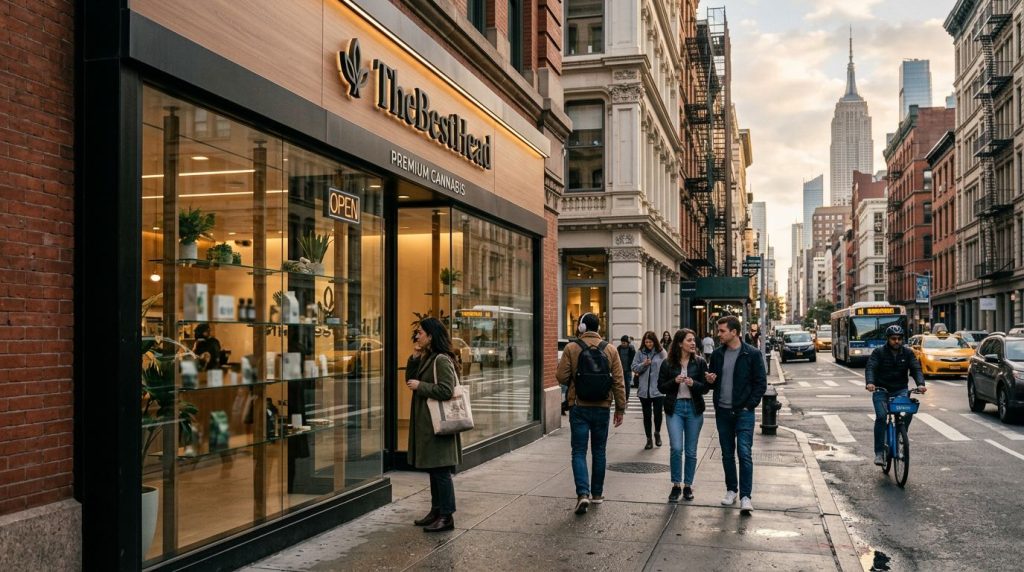
Two licensed dispensaries can meet the same regulatory compliance standards and still feel far apart. In New York City, the block around the store often explains why.
When using directories optimized for local SEO as part of digital marketing efforts to compare licensed locations, neighborhood context helps you read beyond the menu. That matters more in 2026 because New York’s legal cannabis market has evolved into a competitive market, with state sales already past $2 billion and more stores vying for attention. To understand dispensary positioning, you need to look at who lives nearby, who passes through, and how those groups use the neighborhood each day.
Key Takeaways
- Neighborhood demographics shape dispensary positioning by influencing pace, trust, customer experience, service flow, hours, staffing, and merchandising to match local needs like commuter speed or residential education.
- Key signals include age mix, income levels, household types, commute patterns, and familiarity with regulated cannabis, guiding choices from efficient POS for young renters to clinical credibility for older residents.
- Avoid stereotypes; use block-level data over borough generalizations to adapt inventory, loyalty programs, and brand identity for broader markets including women and older adults.
- In NYC, patterns vary by block—fast throughput in dense Manhattan vs. repeat-driven Brooklyn—ensuring coherent positioning from online discovery to in-store feel.
Why the neighborhood changes the store
A medical and recreational dispensary does not operate in a vacuum. Even under the same New York rules, a store near office towers will act differently than one near family housing or a busy subway transfer point.

When you look at positioning through a neighborhood lens, including brand identity and store design, a few things come into focus. First, demographics shape pace. A commuter-heavy area often favors short visits, clear wayfinding, an efficient floor plan, and strong front-of-store flow to the point of sale. A residential area may support longer conversations through budtender training, more repeat traffic, and a stronger local customer base.
Second, demographics shape trust and customer experience. Older adults and first-time legal buyers usually want clarity, consistency, and a calm retail setting. Younger regular consumers may care more about speed, familiar formats, and convenient hours. That does not mean every person fits a category. It means the store has to meet the most common needs around it.
If you want to understand a dispensary, study its block as much as its listing.
You can see that pattern across the city in neighborhood-level comparisons such as Williamsburg, Astoria, and Downtown Brooklyn. The licensed foundation stays the same, but the shopping rhythm shifts with the area.
Good positioning also avoids lazy stereotypes. Demographic data should guide operations, not flatten people into assumptions. A smart store reads population mix, income range, household patterns, and daily foot traffic, then turns that into better hours, better staffing, and a better in-store experience.
The demographic signals that matter most
If you strip the issue down, most positioning decisions start with a few local signals for the target audience. Age mix is one of them. So is income. Household type matters too, as do commute patterns and how familiar residents are with regulated cannabis retail.
This quick view shows how those signals often translate into store choices:
| Neighborhood pattern | Likely positioning choice |
|---|---|
| Younger renters and commuters | Faster service flow, familiar cannabis product categories, later peak hours, point of sale efficiency, interactive displays |
| Older resident base | More education, clearer staff support, stronger clinical credibility |
| Mixed-income households | Wider price range, simple value communication via visual merchandising, balanced assortment |
| Family-heavy residential blocks | Predictable hours, discreet storefront feel, steady local service |
Current market data also shows the customer base is broader than old cannabis stereotypes suggest. Women make up a larger share of buyers than many operators expected a few years ago. Older adults do too. At the same time, easy-to-understand formats and lower-dose cannabis products have gained ground to improve the customer experience. If a store still positions itself around one narrow image of the consumer, it will feel behind the market, especially for medical and recreational needs.
You can also read income data the wrong way if you are not careful. Higher-income neighborhoods may support more premium pricing, but that does not mean every affluent area wants a high-design, high-ticket retail experience. Some customers want efficiency above all else. In mixed-income neighborhoods, price clarity often matters more than polish, best achieved through smart retail merchandising.
Education level can change positioning as well, though not in the way people assume. Higher education areas may produce more research-heavy shoppers who compare brands, ask detailed questions, and expect precise information for the target audience. That pushes stores toward a more transparent, information-led approach. In other neighborhoods, the better move may be plain language, simpler menus, and staff trained to explain basics without jargon.
What this looks like across New York City
NYC makes these differences easy to see because each borough contains several retail patterns at once. A borough label helps, but it never tells the whole story.

In parts of Manhattan, density and commuter traffic can push a store toward fast throughput, strong visibility, and a layout built for short visits, with online ordering through an e-commerce website and point of sale systems optimized for quick cannabis product pickups. In many Brooklyn neighborhoods, the customer base may be more repeat-driven and neighborhood-rooted, so brand identity and brand awareness through social media engagement carry more weight. Queens often turns transit access and parking into part of the positioning story, including digital signage at busy transit hubs. The Bronx and Staten Island may present different access needs again, depending on the block and nearby retail mix.
For a broad citywide view, NYC dispensaries by borough helps frame those differences. Still, borough-level patterns are only a starting point. A store near a college cluster will behave differently from one near long-term residential buildings, even if both sit in the same borough.
Boroughs give you context. The immediate trade area gives you the real answer.
This matters for access too. If licensed retail concentrates too heavily in affluent or highly visible corridors, the legal market can feel uneven. Better positioning is not only about chasing spend. It is also about matching a store to the needs, habits, comfort level, and customer experience of the people nearby, including their preferred cannabis products.
As a reader using a directory, you can often spot this without walking in. Store hours, the tone of the description, neighborhood setting, and review themes all hint at who the store is built for and shape the customer journey from online discovery to the physical store. When those elements line up with local demographics, the positioning feels coherent. When they do not, the store can feel out of step with its own block.
Frequently Asked Questions
Why does the neighborhood matter more than the dispensary menu?
Neighborhood demographics explain differences in positioning beyond compliance or products. They shape pace (quick for commuters, conversational for residents), trust (clarity for first-timers), and experience (efficient flow vs. education). Block context reveals who the store serves, from directories to foot traffic.
How do key demographic signals guide positioning?
Signals like age, income, household type, and commutes dictate operations: younger renters get fast service and late hours; older bases need staff education; mixed-income areas focus on price clarity. Education levels push for transparent info or simple menus. This avoids stereotypes while matching real customer rhythms.
How do NYC boroughs and blocks differ for dispensaries?
Boroughs provide context—Manhattan favors quick pickups, Brooklyn builds repeat loyalty—but the block gives the answer, like college areas vs. residential. Queens emphasizes transit, Bronx access varies. Spot it in hours, descriptions, and reviews aligning with local demographics.
What role does dispensary positioning play in the competitive market?
With NYC sales over $2B, positioning matches evolved buyers (women, older adults, low-dose products) via tailored inventory, loyalty, and marketing. It builds community loyalty and repeat business. Poor alignment feels out of step with the block and market.
Final thoughts
Neighborhood demographics shape more than who walks through the door. They influence pace, trust, pricing, education style, and the overall feel of a licensed dispensary, while informing your marketing strategy and dispensary positioning.
Studying these demographics leads to smarter inventory management of cannabis products, tailored loyalty programs that enhance customer experience, and unwavering regulatory compliance. Loyalty programs customized to neighborhood preferences build repeat business and community loyalty.
If two NYC stores look similar on paper, the surrounding neighborhood often explains the difference. When you compare licensed dispensaries, the menu of cannabis products matters, but the block usually tells you more.


