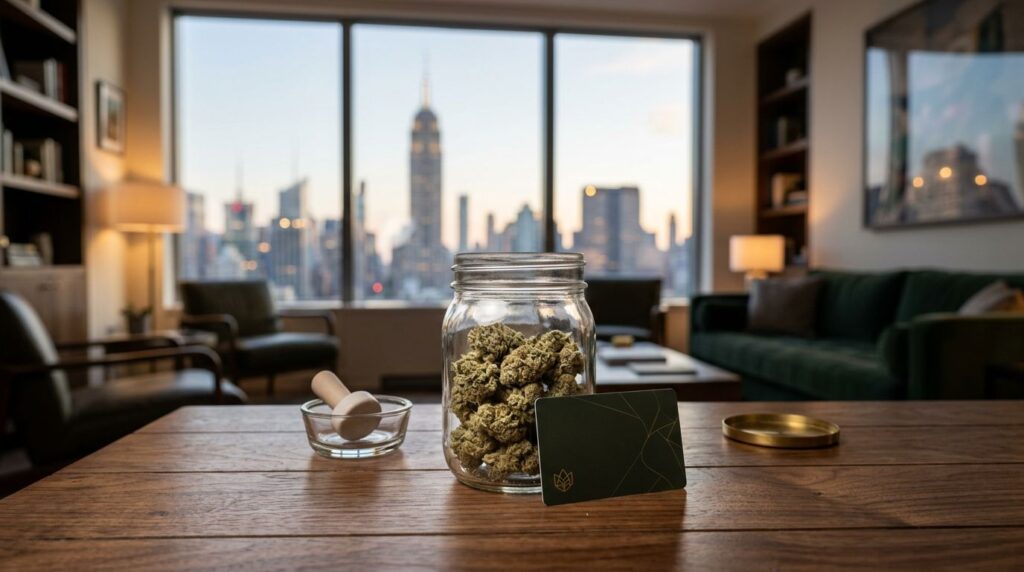
A cannabis social club can sound like a simple idea: a place where adults gather, meet people, and consume cannabis together. In New York City, the legal reality is more complicated.
NYC cannabis social clubs are not a separate, automatic category under New York’s adult-use cannabis rules. If you are considering joining one, hosting an event, or evaluating a venue, you need to know what the club is licensed to do, if anything.
The difference between a legitimate private gathering and an unlicensed cannabis business can come down to how cannabis is supplied, sold, and consumed.
Key Takeaways
- A membership model does not give a club permission to sell, distribute, or provide cannabis without the required state license.
- Adults must be at least 21 to possess or consume adult-use cannabis in New York.
- Licensed dispensaries are the legal retail source for adult-use cannabis products.
- New York City rules can restrict smoking and vaping in indoor spaces, even when cannabis possession is legal.
- Before attending a club or event, confirm its cannabis policy, age rules, venue rules, and whether any cannabis transaction is involved.
What NYC Cannabis Social Clubs Usually Mean
In everyday conversation, a cannabis social club is often a members-only group, lounge, event series, or private community built around cannabis culture. Some groups focus on education, music, food, art, or networking. Others promote a more traditional bring-your-own-cannabis format.
The name itself does not tell you whether the operation is legal. A club may have a membership fee, a door policy, and a private venue, yet still lack permission to sell or distribute cannabis. Membership is not a substitute for a cannabis business license.
New York’s adult-use cannabis system has distinct license types for activities such as cultivation, processing, distribution, retail dispensing, delivery, and on-site consumption. A business needs the appropriate authorization for the activity it conducts. Calling a location a “club,” “collective,” or “private event” does not change that requirement.
For adults, the key distinction is straightforward. You can legally obtain cannabis from a licensed New York dispensary and possess it within state limits. However, a venue cannot use its social-club model to bypass retail licensing rules.
A private membership card does not turn an unlicensed cannabis transaction into a legal one.
Some NYC clubs may operate as cannabis-adjacent communities. They might host discussions, ticketed events, or member gatherings without handling cannabis at all. Others may allow attendees to bring their own legally obtained products, subject to the property’s rules and applicable smoking restrictions.
That distinction matters because the law focuses on conduct, not branding. If a club takes payment connected to cannabis, transfers products to members, or includes cannabis with admission, it may raise serious licensing and compliance concerns.
Why Membership Does Not Create a Cannabis License
New York legalized adult-use cannabis for people 21 and older, but legalization did not create an open market for any business that wants to sell it. The state regulates commercial cannabis through the Office of Cannabis Management, commonly called the OCM.
A licensed adult-use retail dispensary can sell cannabis products that have entered the regulated supply chain. Those products must meet state testing, packaging, labeling, and tracking requirements. When you buy from a licensed retailer, you can review product information and confirm that the business appears in the state’s authorized system.
An unlicensed club may describe a payment as a donation, membership charge, cover fee, or event ticket. Labels do not settle the issue. If the payment is tied to receiving cannabis, regulators may view the transaction as an unlicensed sale or distribution.
You should also be cautious when a club claims it can “gift” cannabis with another purchase. New York’s adult-use rules do not create a broad loophole that lets businesses give cannabis away alongside merchandise, food, entry fees, or memberships.
The same principle applies to delivery promises. A social club cannot legally offer cannabis delivery unless it has the relevant state authorization. A private gathering also does not give an organizer authority to transport cannabis commercially or distribute it to attendees.
Legal retail businesses must verify age, follow inventory controls, and sell products from licensed New York operators. A club that skips those steps places members in a difficult position. You may not know where the products came from, whether they were tested, or whether they meet state packaging standards.
For that reason, the safest route is to keep retail cannabis purchases separate from club membership, event admission, and social participation.
Where Cannabis Can and Cannot Be Consumed in NYC
Possessing cannabis and consuming it in a particular place are separate questions. New York generally permits adult cannabis consumption where tobacco smoking is allowed, but property owners, employers, and local rules can impose tighter restrictions.
In New York City, indoor smoking and vaping rules are particularly important. The city’s Smoke-Free Air Act restricts smoking and vaping in many workplaces, bars, restaurants, and public indoor areas. A venue’s private-event label does not automatically remove those restrictions.
You should not assume that an indoor lounge, rented event space, gallery, restaurant back room, or nightlife venue permits cannabis consumption. The property owner may prohibit it. Building rules may prohibit it. City regulations may prohibit it.
Outdoor spaces require care as well. Public consumption can create problems when smoking is prohibited in the location. Parks, beaches, transit areas, building entrances, and shared spaces may have their own restrictions. Cannabis consumption is also prohibited in motor vehicles, whether you are driving or riding as a passenger.
A responsible social gathering sets expectations before guests arrive. Clear policies can cover:
- Whether attendees may bring legally purchased cannabis for personal use.
- Whether smoking, vaping, or any consumption is permitted at the venue.
- Which areas, if any, are designated for lawful adult use.
- How the organizer verifies that all attendees are 21 or older.
- Rules for alcohol, tobacco, transportation, and respectful conduct.
If an event avoids cannabis sales and complies with venue rules, it may function as a cannabis-friendly community gathering. That still does not make every form of consumption lawful. The venue and the event format both matter.
New York’s regulatory system also includes the concept of licensed on-site consumption. That model is different from an informal social club because it requires state approval and operates under formal rules. If a location presents itself as a consumption lounge, you should verify its license status before treating it as a regulated business.
How to Evaluate a Cannabis Club or Event
You do not need to investigate every event like an auditor. Still, a few direct questions can help you avoid an uncomfortable or risky situation.
Start with the most basic question: does the club sell, provide, include, or arrange cannabis? If the answer is yes, ask whether the organization holds a New York cannabis license that covers the activity. A legitimate operator should be able to describe its business clearly without vague promises about donations or members-only exceptions.
Next, confirm the age policy. Adult-use cannabis is for people 21 and older. A responsible event should check identification and should not market cannabis access to anyone underage.
You should also ask about the venue’s consumption policy. Don’t rely on social media photos or assumptions based on the event theme. Indoor consumption may violate city rules or the property’s terms, even if everyone attending is an adult.
Consider the practical details before you go:
- Read the event description for clear rules on cannabis, smoking, vaping, and alcohol.
- Check whether the venue is a licensed cannabis business or only a private rental space.
- Bring only cannabis obtained from a licensed New York retailer if personal possession is permitted.
- Avoid driving after using cannabis, and plan your trip home before the event begins.
- Leave if organizers pressure you to buy untested products or participate in unclear transactions.
A well-run cannabis community event will not hide the basics. You should know where it takes place, who is hosting it, what the admission covers, and what conduct is allowed. Ambiguity is not a sign of exclusivity. It is often a warning that the organizer has not built a compliant operation.
The Difference Between Community and Commerce
Cannabis culture has always included shared experiences. In NYC, that can mean educational panels, art nights, industry networking, comedy shows, or small gatherings among friends. Adults can build community around cannabis without turning the gathering into an unregulated retail operation.
The line becomes sharper when money and product change hands. A paid membership can support a community organization, but it cannot include unlicensed cannabis access. A ticket can cover entertainment or venue costs, but it should not disguise a cannabis sale. A host can discuss cannabis brands, but product promotion should not become an unlicensed transaction.
This separation also protects consumers. Licensed New York cannabis businesses operate with product testing, child-resistant packaging, potency information, and traceable supply chains. Those safeguards matter when you want to know what you are consuming.
For club organizers, compliance starts with restraint. If you want to create a gathering for adults who appreciate cannabis, build the event around the community itself. Use clear age gates, work with venue rules, and avoid handling cannabis unless your business has the required authorization.
For attendees, the same approach keeps the experience simpler. Treat a social club as a social setting, not as a substitute dispensary. If you want to explore legal products, use licensed retail listings and verify the business before you visit.
A Clearer Way to Enjoy Cannabis Community in NYC
NYC cannabis social clubs can offer connection, education, and cultural experiences for adults. However, a club name, paid membership, or private door policy does not create legal permission to sell or distribute cannabis.
The most reliable approach is to keep cannabis purchases within the licensed market and treat social events as separate community spaces. When a club is transparent about its rules, venue, and role, you can make an informed decision before attending.
Legal cannabis culture works best when the social experience respects the same rules that protect adult consumers.